Registered Master Builder 2011
Supreme Award & Bay of Plenty Commercial Project of the Year
NZIOB Awards 2011
John Overton & John Sofo (ASC Architects) - Winners Supreme Award & Sustainability Category
Hawkins recent track record on new-build schools is highlighted by projects such as the integrated Mission Heights Junior College and Primary schools, and Botany Downs Secondary College. So when the Government gave the final go ahead in June 2009 for the fast track delivery of Papamoa College to begin classes at the start of 2011, Hawkins were awarded the task of delivering a fully operation school campus in just 18 months.
The tight time frame given to design and build Papamoa College was a result of efforts to implement the $7 billion stimulus package, announced by the incoming National Government in November 2008.
“This project was about six months shorter than what we would normally term ‘quick’, “says John Overton, Hawkins Construction’s project manager. “It was a design and build that at times looked a lot more like ‘build and design’."
The result is the fastest secondary school delivered in the history of New Zealand.
Like the recent East Auckland school projects, Papamoa College was another design and build project for the Ministry of Education; led by Hawkins Construction and incorporating the skills of ASC Architects and GHD on services engineering. Buller George Turkington joined the team for this project as structural engineers.
The brief was to have a fully functioning Year 7-13 school campus designed, consented and constructed in 18 months utilising the new open-plan ‘learning commons’ layout and with an extremely high earthquake performance rating due to local seismic risks and the sand based ground conditions
“The fast-track project quite simply owes its success to the teamwork and commitment demonstrated by everyone involved in the job,” says Overton.
Papamoa College’s current configuration has four main components - the learning commons occupying the wings of the "Y", the bridge and elevated walkway, and the two single-story buildings; a superb physical education and gym and a performing arts centre with facilities for theatre, dance, and sound recording.
With 660 teaching places (expandable to 1100 when the "Y" will grow into an "X"), the combined intermediate and high school forgoes cellular classrooms to support the modern pedagogical approaches to teaching where learning is not subject-based but inquiry-based, and places the student at the centre and actively involved in their education.
The school is equipped with a high degree of technology to aide learning and research and supported by a design that includes with six learning commons and a large number of specialist areas. Each learning commons is large enough to give instruction to up to 100 students. These large spaces are equivalent to four regular classrooms and their corridors.
These areas can be either opened up or separated into learning spaces for groups of various sizes. Students will generally learn alongside others of their own year - but flexibility is there to combine years, whenever useful to do so. The learning commons are infinitely flexible; they even have wet areas that comprise of sinks and bench space.
Construction of the school was made more complex by the site conditions: the school is built on sand in an area of high seismic activity, so significant foundation work was required to ensure its stability.
“Earthworks began in late 2009 and the foundations were not completed until early 2010. Subsequently, we only completed all the drawings in the last quarter or 2010 - at times construction actually ran ahead of the plans” says Overton. “The Tauranga City Council inspectors really bent over backwards to streamline the consenting process.”
The ‘belt and braces’ foundation and piling system called for a virtual forest of 550 tree trunks, each 300mm in diameter and six metres long. They were driven through a top layer of hard sandy soil, through a looser layer below that, and finally into another solid layer. These poles were married to foundations, with four such piles under each pile cap resulting in tremendously strong foundations.
The result is a building that is deisgned to protect the lives in the event of a one in 1,000-year earthquake and then remain functional afterwards.
The extensive ground works placed considerable strain on the budget for the project. Particularly at risk was the glazed façade, which was scheduled to be fitted towards the end of the project.
“This kind of façade would normally be too expensive for a school, but we managed it all thanks to some wise shopping, and by making extensive use of our networks,” says Mr Overton. “We called in every favour and accomplished everything the plans called for.”
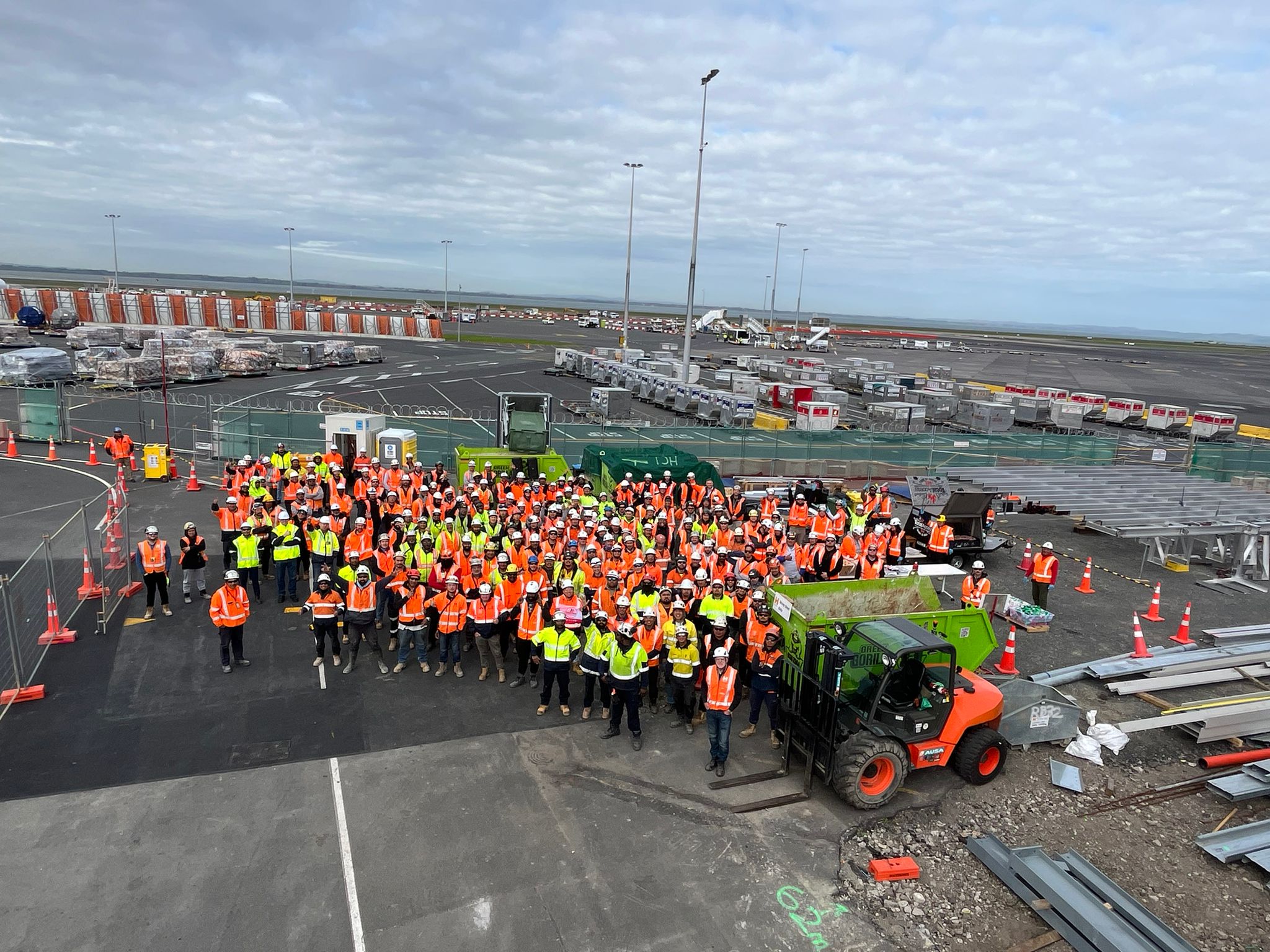
There were 180 mostly local subbies on-site at the peak of the operation including everyone from drain layers and carpenters to glazers and landscapers. It was the Department of Education’s wish that the skills of resources of the local community be put to work wherever possible for the project.
Overton says the subbies were the most highly skilled and certainly some of the most diligent and motivated he’d worked with for a long time.
“There was excellent buy-in to our safety standards and, with our safety officer’s diligence, we achieved an outstanding safety record for the project,” he says. “Guys just seemed pleased to be building a college for their own community, and it showed in their attitude and workmanship”.
“Because they were mostly local, they took real Tauranga pride in their work, making this school project outstanding. This careful detailing comes out of a caring attitude, both from the tradesmen concerned and by Hawkins Construction itself. We put quality ahead of everything else”.
The school has been designed and built to the New Zealand GreenStar rating system (5 Stars) and represents the first “single stacked” learning commons configured school in New Zealand. This design has allowed the building to perform well for natural light and ventilation that has enabled efficiencies in energy consumption for lighting and HVAC services as well as improving the general quality of indoor learning environment.
Registered Master Builder 2011
Supreme Award & Bay of Plenty Commercial Project of the Year
NZIOB Awards 2011
John Overton & John Sofo (ASC Architects) - Winners Supreme Award & Sustainability Category